Keep care independent of service.
Would recruitment still work if refusing left pensions and care untouched? What would the state have to offer instead?
A future by Antony Butts
Your country needs your gran. Would that change who supports a war?
If technology changes who can serve, it could also change who supports a war. People asked to bear its dangers may judge the case for fighting differently.
Service buys care and a full pension. Refusal puts the family inheritance at risk. A recruitment problem becomes an extraordinary bargain that nobody quite feels free to refuse.
Speculative fiction by Antony Butts. These campaign materials and the letter are fictional.
The familiar picture
An ageing population strains defence, pensions and care.
The reversal
What if the state offered to fund your old age in exchange for front-line service?
Robotics makes older recruits useful. Young people become too valuable to lose. Care bills and inheritance give families a reason to accept a bargain they once found unthinkable.
Suppose a major war creates dangerous jobs that still need people, but no longer demand youthful strength. Younger citizens are scarce; their work keeps civilian life going. Older citizens can serve. Who should bear the risk?
That question could turn mobilisation into a struggle over the bargain between generations. Care Home Troopers follows one disturbing answer. It depends on a crucial condition: enough roles must exist that older people can perform and affordable robots cannot fill.
01 / Make it desirable
Vigilance. Determination. Survival instinct. A recruitment campaign turns insults into military virtues.
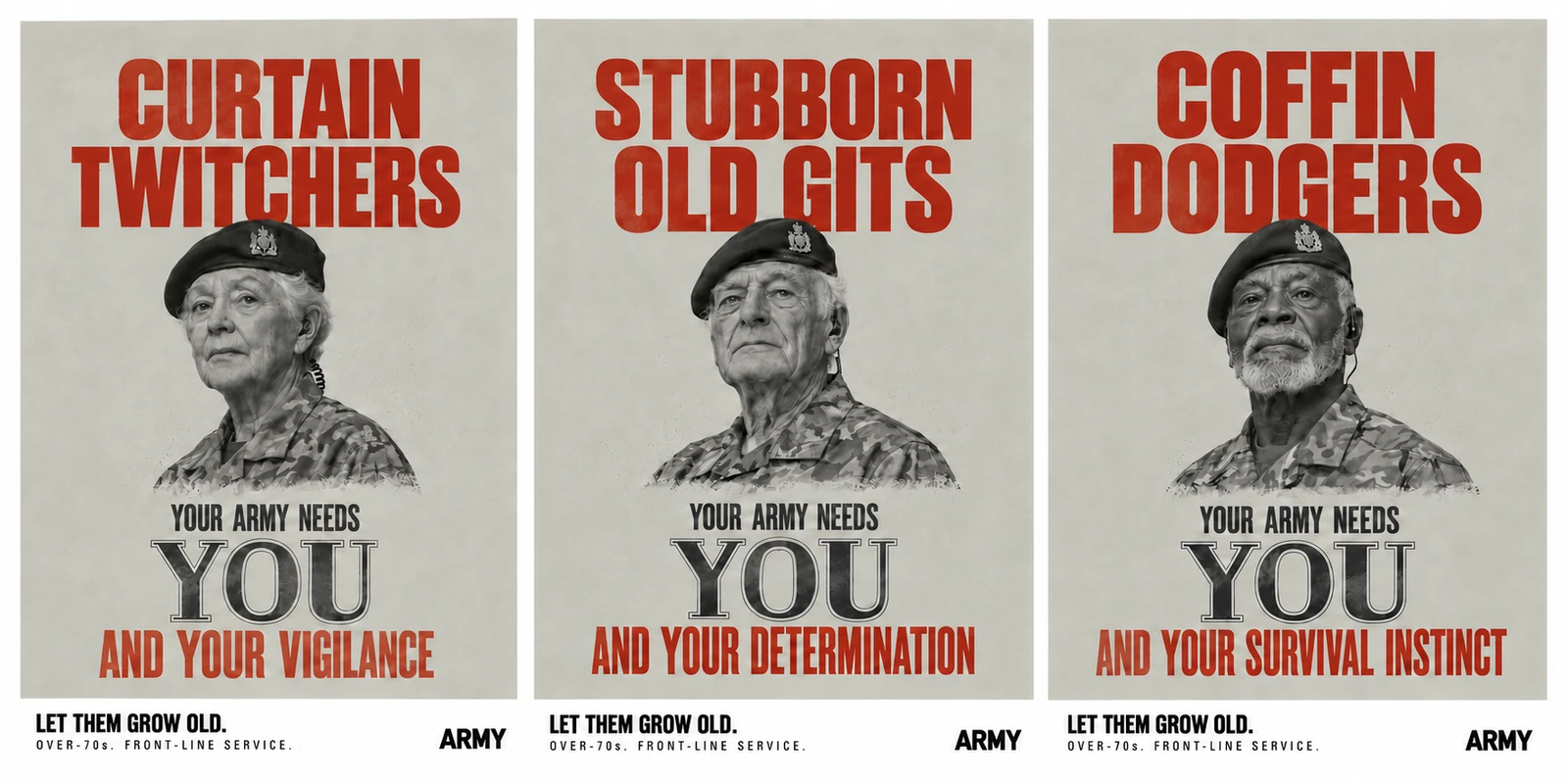
02 / Make it pay
The appeal shifts from patriotism to the care bill. Service protects the family home. Refusal starts to look selfish.
The strategic risk sits between policies: a military staffing problem becomes a solution to a care-funding problem, paid for by people with fewer alternatives.

03 / Make it routine
Colin is 76. He is eligible with adaptations. He can enlist, request a review, or decline and lose care funding and part of his pension.
The form does the work the posters began. The extraordinary bargain has become an administrative choice.
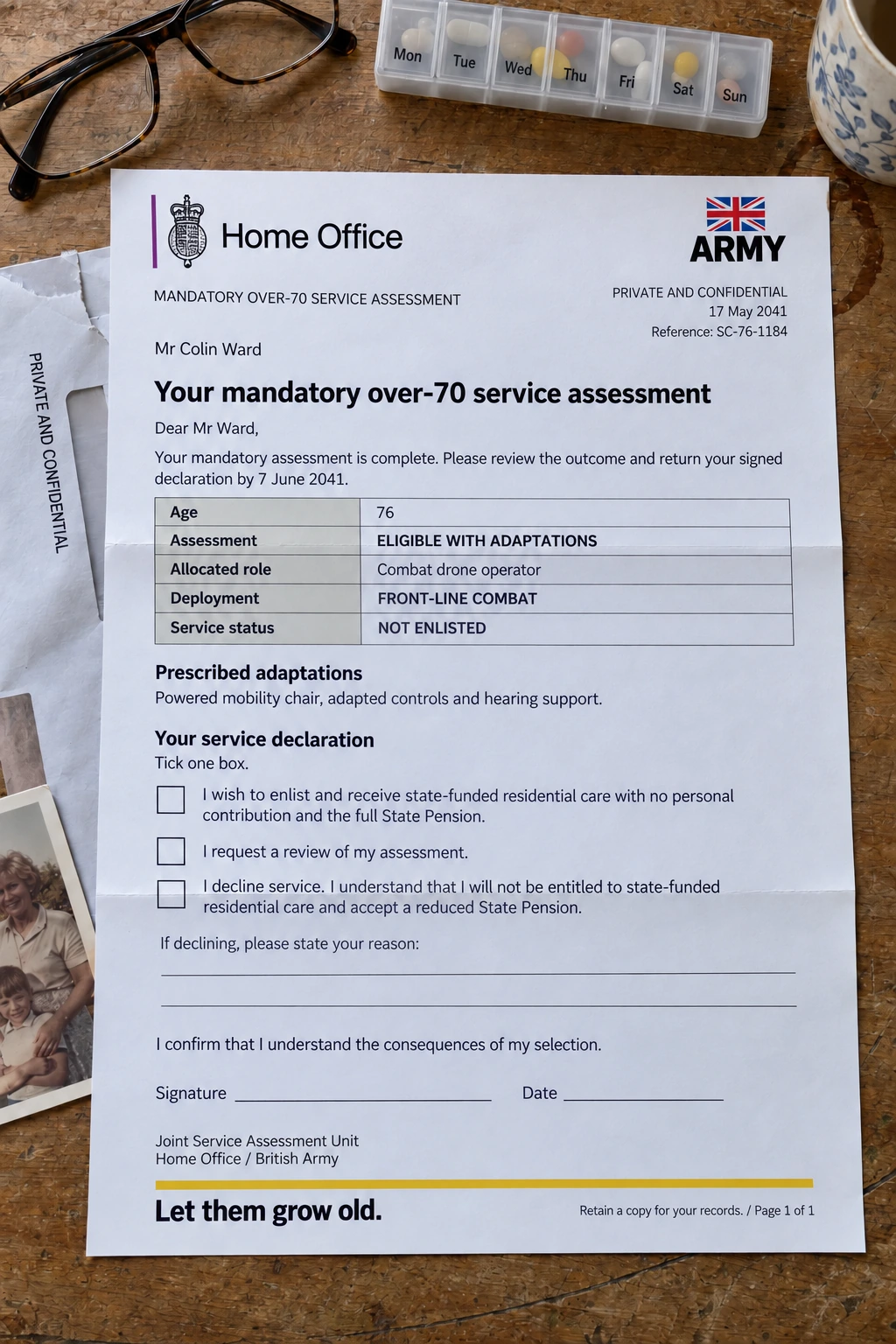
Keep the military capability. Change the bargain around it.
Would recruitment still work if refusing left pensions and care untouched? What would the state have to offer instead?
Remote roles, civilian work or front-line deployment create different bargains. Who gets to decide which one counts as service?
Let older recruits, families, defence and care providers argue their best case. Where does consent become pressure?
GO FURTHER
Tell us who you are and what you are exploring. Simon and Antony review each request and reply with the material available to share.
Tell us the decision you face, what is changing and what your current view may be missing.